
The emission situation
Stage IV
- Beginning in 2014, the most stringent governmental emissions standards in history went into effect for high-horsepower, off-road equipment.
- Case IH met the Stage IIIb challenge with a fuel-efficient SCR after-treatment system.
- SCR-only! Case IH continues the commitment to meet Stage IV (Tier 4 Final) emission standards without exhaust gas recirculation and without particulate filter.
- Stage IV: 80% further Nitrogen Oxide (NOx) reduction compared to Stage IIIb. No further reduction of Particulate Matter (PM).
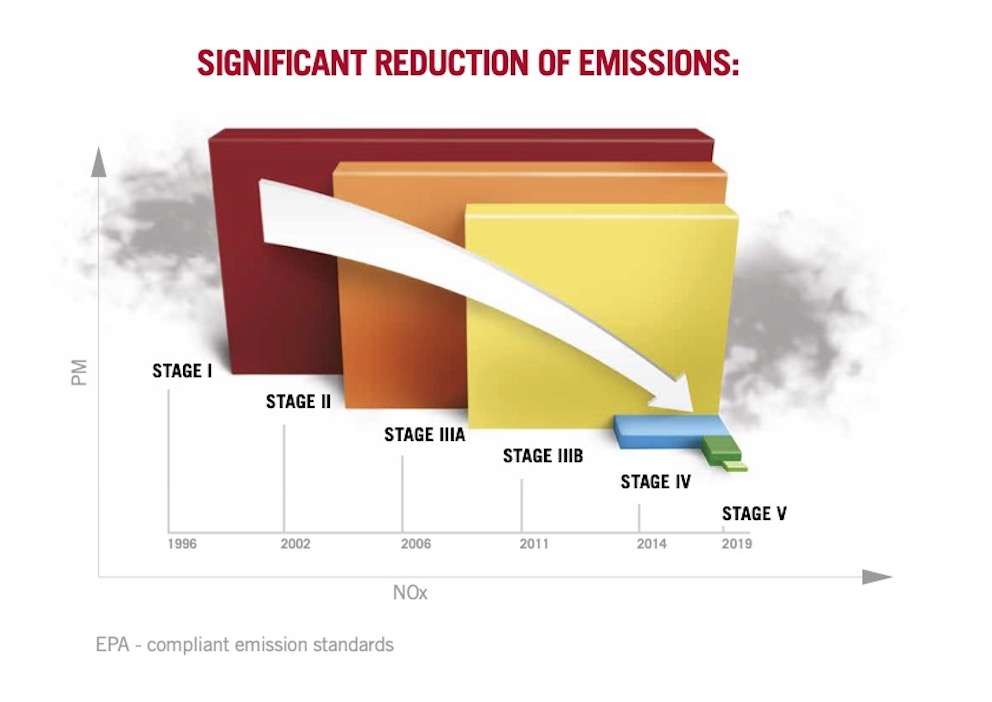
Stage V, the new regulatory step introduced in Europe in 2019/2020 (depending on engine power level), further tightens the limits on PM emissions: admitted PM quantity has been reduced by 40% compared to Stage IV and a new limit has been introduced on the number of emitted particles (Particle Number Limit, PN).
The emission dilemma
Designing a powerful engine that meets the most stringent emissions standards . Emission requirements may be changing, but you’re dealing with the same production challenges and demands you always have. That’s why you need equipment that will not only able to meet the most stringent emissions standards, but will also deliver the power and performance you expect.
Diesel Engine Facts
- Inside the combustion chamber, Particulate Matter (PM) and Nitrogen Oxides (NOx) have conflicting chemical factors.
- No diesel engine can be designed to meet both PM and NOx emission standards without the use of an exhaust treatment system.
a Trade off is necessary When the engine is operating most efficiently for power, minimal PM is produced. However the NOx levels are very high. When exhaust gas is re-circulated back into the intake, the NOx production is reduced. However the higher levels of PM are created. In either situation, an exhaust after treatment system is needed to reduce the levels of remaining pollutants.
What are PM and NOX? Particulate Matter (PM) is composed of minute particles and pollutants, which pose serious health risks for people and animals. Nitrogen Oxides (NOx) contribute to the cause of acid rain and ground level ozone.
What are the options?
SCR vs. EGR SCR (Selective Catalytic Reduction) SCR is a simple system that maximises engine power and treats exhaust gases with a second fluid to eliminate pollutants. + More power : Engines are tuned for maximum horsepower, without compromising efficiency for emissions, resulting in better performance. + Fuel economy : Fine-tuning the combustion process and eliminating exhaust gas recirculation provides substantial improvement in fuel efficiency. + Reliability/Durability : Greater durability, increased reliability and lengthened service intervals are all achieved by eliminating the recirculation of exhaust gas contaminants back into the engine. - Additional fluid : Requires the use Diesel Exhaust Fluid (DEF).
EGR (Exhaust Gas Recirculation) EGR re-circulates exhaust back into the engine and uses a particulate filter to capture pollutants. + No additional fluid : Does not require Diesel Exhaust Fluid (DEF). - Larger Engine Cooling Package : Re-circulating 25-30% hot exhaust gas in the engine has a major impact on the cooling system, particularly on large engines under high-duty cycles. - Hot Exhaust Temperatures : During required particulate filter regeneration, exhaust temps can reach up to 1292°F, which is nearly twice the normal operating exhaust temperature. - Increased Maintenance Cost : Oil change frequency increases due to higher levels of exhaust gas recirculation
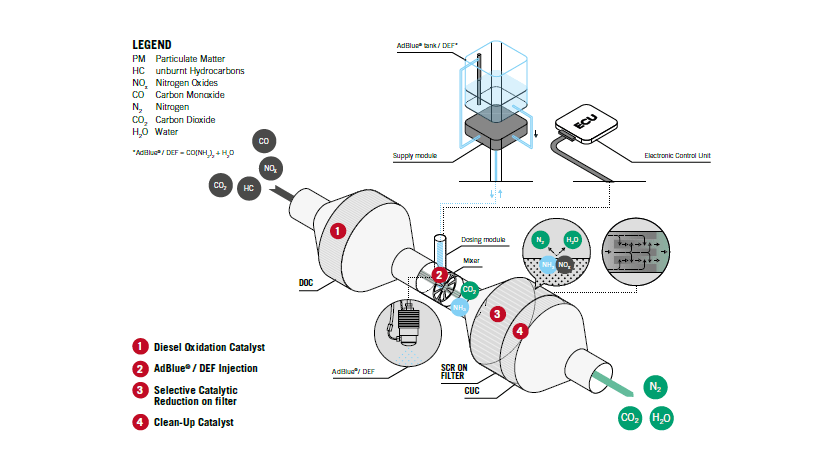
The Stage V Emission Solution: Right From The Startsituation
To maintain the advantages of the unique and unbeaten HI-eSCR technology, FPT Industrial has integrated a maintenance-free filtering device on its SCR catalyst, thus allowing to comply with tightened limits on PM emissions within a compact package.
READ MORE10 reasons why SCR is the right choice
1. Lower fuel consumption
The efficiency of the combustion process and smaller engine displacement, combined with greater horse power, optimises fuel consumption.
2. Outstanding performance
Since SCR is an after-treatment system, the engine is designed to maximize torque and power with faster response in the field.
3. Longer service interval
The optimised combustion process preserves oil’s physical properties, reducing maintenance activities and related downtime.
4. High reliability
SCR system allows the engine to reduce heat rejection of many internal engine components, leading to better reliability.
5. Unbeatable durability
The reduction of PM inside the engine eliminates clogging problems and the need for regeneration often required with EGR.
6. Compact packaging
SCR systems are more thermodynamically efficient than Tier 3/Stage IIIA engines. This allows for greater horsepower from smaller engines.
7. Wide fuel compatibility
SCR systems work regardless of fuel quality and are not influenced by the presence of traditional pollutant substances in the fuel. No part of Stage V particulate control involves the use of ultra-low sulfur diesel.
8. User-friendly solution
SCR systems are simple. The only thing you have to do is refill the DEF at regular fuel intervals.
9. Environmental care
Pollutants produced during the combustion process are converted into harmless N2 and H2O, already present in the environment.
10. Advanced technology
SCR is recognized by many engine manufacturers as the technology of the future to be compliant with Stage V.